In short
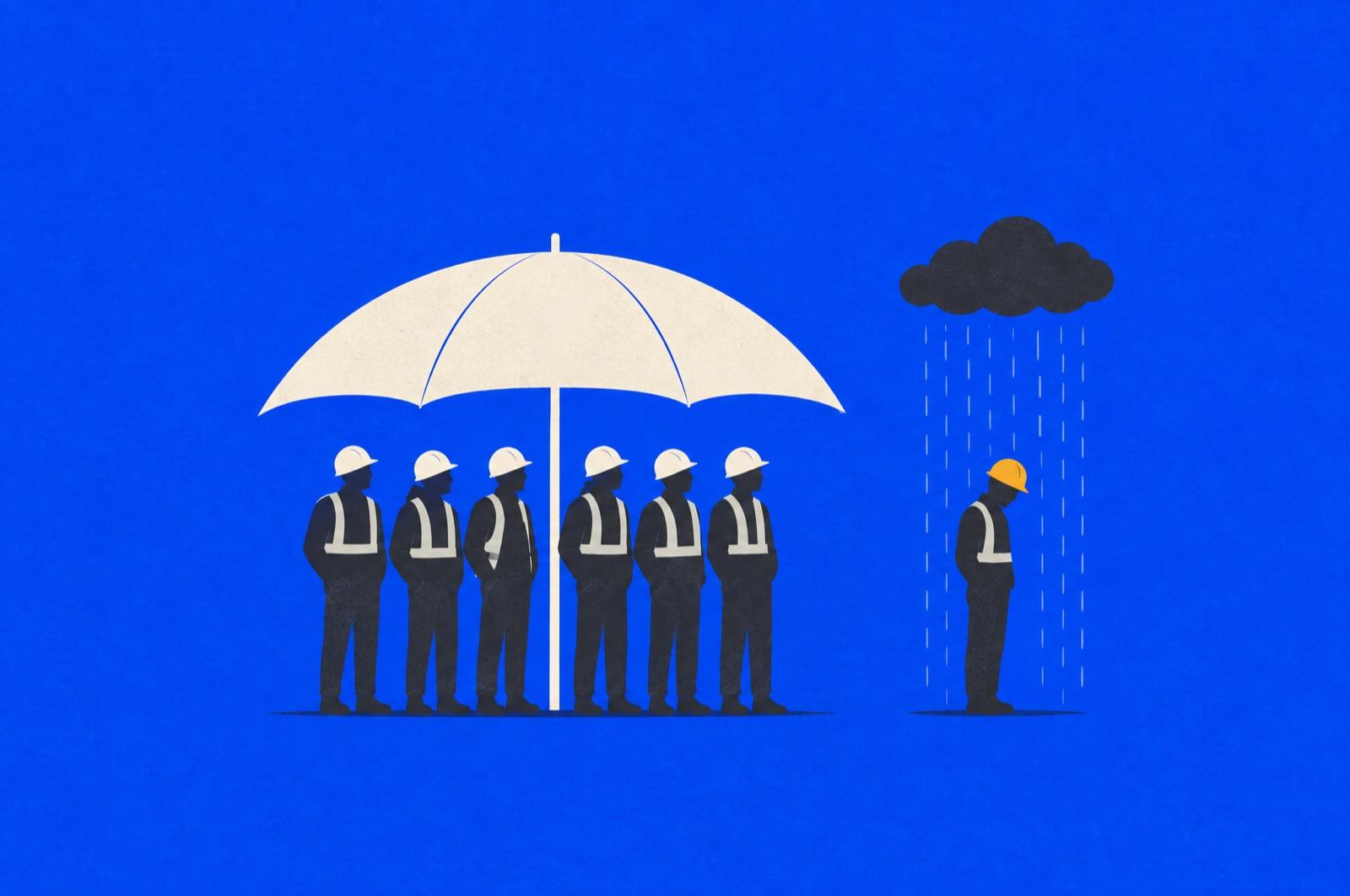
- When a site stops because of the weather, the employer can claim bad weather compensation from unemployment insurance, which covers 80% of the wage for the hours lost.
- Temporary workers (temps) are not entitled to this compensation: the agency, as their employer, remains responsible for the question of their wage.
- In strong heat, the employer must protect your health: Suva recommends 15-minute breaks every hour from 33 °C and keeping very hard work to a minimum.
I am a temp worker: who pays me?
This is the most important point for temps. The law is clear: workers of a temporary employment agency are not entitled to bad weather compensation (art. 43a let. d AVIG/LACI). The official unemployment insurance website says it again: temporary workers and workers hired out by another company are not entitled to it.
Your employer is the agency. Two general rules exist:
- The Code of Obligations (OR/CO) says that if the employer cannot accept your work, it is in principle still required to pay the wage (art. 324 CO).
- When the site company is covered by an extended agreement, like the LMV/CN for structural work, the agency must apply its rules on wages and working time (art. 20 of the Recruitment Act, AVG/LSE).
The Recruitment Ordinance lists among these rules normal working time, overtime and waiting time (AVV/OSE, art. 48a para. 2). The official commentary on the collective labour agreement for staff leasing (GAV Personalverleih / CCT Location de services) confirms it: on a site covered by the LMV/CN, the LMV/CN rules on wages and working time, overtime included, replace those of the staff leasing agreement (commentary on art. 3 and 12).
However, no text says exactly what the agency must pay a temp paid by the hour when the site stops for bad weather: planned hours paid, hours carried over, or nothing. The answer depends on your assignment contract and on how the agency applies the LMV/CN.
The right reflex: ask your agency, in writing, how it handles hours lost to bad weather, and keep a record of your planned hours and the days stopped. Good to know: according to the same commentary, the staff leasing control bodies do not in principle check a shortfall of hours caused by the employer (art. 324 CO). If there is a dispute on this point, the labour court decides; a trade union can advise you first.
Who decides to stop the site?
The National Collective Agreement for the main construction sector (LMV/CN 2026-2031, the collective agreement for structural work) says it clearly: when the weather puts workers' health at risk or prevents proper work (heatwave, rain, snow, lightning, severe cold), outdoor work must be interrupted if this is technically possible (art. 30 para. 2 LMV/CN).
- The employer orders the stop. They must consult the workers concerned before deciding (art. 30 para. 3 LMV/CN).
- During the stop, you stay available to restart at any time, unless the employer lets you go (art. 30 para. 4 LMV/CN).
- The employer can also give you other reasonable work, meaning usual work in the trade that you know how to do (art. 30 para. 5 LMV/CN). For example tidying the depot or preparing material under cover.
How much do I get if the site stops?
If you are employed directly by the construction company, it can claim bad weather compensation (Schlechtwetterentschädigung, often called INTEMP in French) from unemployment insurance. Here are the main rules (Unemployment Insurance Act, AVIG/LACI, art. 42 ff.):
| Rule | What the law says |
|---|---|
| Amount | 80% of the wage for the hours lost (art. 34 and 44 AVIG/LACI) |
| Minimum length of the stop | Half a day or a full day; a loss of at least 50% of a day counts as half a day (art. 43 AVIG/LACI, art. 66 AVIV/OACI) |
| Waiting period | 2 days deducted per month for the first 6 periods, 3 days after that (art. 67a AVIV/OACI) |
| During the waiting period | The employer pays the compensation itself (art. 37 and 46 AVIG/LACI) |
| Maximum length | 6 settlement periods (months) within 2 years (art. 44a AVIG/LACI) |
| Who makes the claim | The employer alone, to the cantonal authority, by the 5th of the following month at the latest |
What this means for you:
- Your employer pays you, on the usual payday. It advances the compensation, then the unemployment fund pays it back (art. 37 AVIG/LACI).
- You get 80%, not 100%, for the hours lost.
- Social contributions (old-age insurance AHV/AVS, unemployment...) are still paid as if you had worked normally (art. 37 AVIG/LACI).
- For the waiting days, the LMV/CN says the employer counts the average length of a working day in your annual working time (art. 30 para. 6 LMV/CN).
Careful: if you refuse the work stop, the loss is not covered by the insurance, and your employment contract applies (art. 43a AVIG/LACI).
An "indirect" loss does not count either: for example a delivery delay or a client lost because of the weather (art. 43a AVIG/LACI).
Can the employer make me catch up the hours?
Yes, the LMV/CN offers other solutions than the compensation:
- Changing the work calendar afterwards, because of the bad weather. The following weeks can then be longer, up to 48.00 h at most, but only for the future and linked to the stop (art. 27 para. 4 and 5 LMV/CN).
- Using your overtime: to avoid working in strong heat or bad weather, the employer can order time off in lieu, even by the hour (art. 28 para. 4 LMV/CN).
- Negative hours: if you work less than planned, these missing hours can be carried over up to 20.00 h (with a work calendar). Beyond that, they are at the employer's expense, unless it is your fault (art. 28 para. 7 LMV/CN).
And if, at the end of the year, there were fewer hours to catch up than hours lost, the employer cannot lower your wage because of it (art. 27 para. 6 LMV/CN).
What about heatwaves?
Heat is one of the conditions that must lead to work being interrupted under the LMV/CN (art. 30 para. 2 LMV/CN). The State Secretariat for Economic Affairs (SECO) reminds employers that they must plan and put in place measures against heat and sun, from April to September.
Suva gives guidelines by temperature:
| Temperature | Measures recommended by Suva |
|---|---|
| Up to 27 °C | Cool water or lightly sweetened tea available, shaded areas for work and breaks |
| From 28 to 32 °C | Adapt the work pace; adapt working hours, for example start earlier |
| From 33 °C | Keep very hard work to a strict minimum; extra breaks in the cool and shade, 15 minutes every hour |
Can a stop because of heat be covered by bad weather compensation? The law does not name heat. It covers stops caused only by the weather, when the work "cannot be demanded of the workers", and only counts half days or full days (art. 43 AVIG/LACI). A stop of only a few hours, shorter than half a day, therefore does not count. If your site stops for the heat, ask your employer whether it has reported the stop to the cantonal authority: if in doubt, that authority examines the case and can refuse the compensation (art. 45 AVIG/LACI).
What if I work in another trade?
The LMV/CN applies to the main construction trades: bricklayers, formworkers, labourers and machine operators in civil engineering. The other trades on site, such as painter, plasterer, electrician, tiler or carpenter, have their own collective agreement, with their own rules on stops and making up hours. Ask your agency or your employer which one applies to your assignment.
Two things are true for everyone:
- a temp worker is not entitled to the bad weather compensation of unemployment insurance, whatever the trade (art. 43a let. d AVIG/LACI);
- this compensation only exists in certain outdoor branches set by the ordinance (art. 65 AVIV/OACI): a permanent employee can ask the employer whether their branch is one of them.
An example
Fictional example. Marco is a mason, a permanent employee of a structural work company covered by the LMV/CN. He earns CHF 32.00 an hour. According to his company's calendar, a day counts 8.10 h. In January, the site is stopped for 3 full days because of snow. Marco accepts the stop.
- Hours lost: 3 × 8.10 h = 24.30 h
- Normal wage for these hours: 24.30 h × CHF 32.00 = CHF 777.60
- Compensation at 80%: CHF 777.60 × 80% = CHF 622.08
- Difference compared with a normal month: CHF 155.52
Marco receives the CHF 622.08 from his employer, with his usual wage. If this is one of the first 6 compensation periods, 2 of these 3 days are waiting days: the employer pays them itself at 80% and the fund only pays it back for the 3rd day.
If Marco were a temp from an agency on the same site, this calculation would not apply: see the temp work section.
Frequently asked questions
I am a temp worker, am I entitled to bad weather compensation?
No. The law excludes people working for a temporary employment agency. Ask your agency how it pays these hours.
If the site stops for rain, do I lose my day?
Not necessarily. If you are a permanent employee and the employer claims bad weather compensation, you get 80% of the wage for the hours lost. The employer can also give you other work or change the calendar.
Do I have to stay on site during the stop?
You must stay available to restart at any time, unless the employer tells you that you are free.
It is over 33 °C, do we have to stop?
The LMV/CN says outdoor work must be interrupted when heat puts health at risk, if this is technically possible. Suva recommends at least 15 minutes of break per hour from 33 °C. If in doubt, talk to your supervisor, your agency or Suva.
- Unemployment Insurance Act (AVIG/LACI), art. 34, 37, 42 to 48, accessed 02.10.2026
- Unemployment Insurance Ordinance (AVIV/OACI), art. 65 to 67a, accessed 02.10.2026
- arbeit.swiss (SECO), Bad weather compensation, accessed 02.10.2026
- National Collective Agreement for the main construction sector 2026-2031, art. 27, 28 and 30 (SBV/SSE, French), accessed 02.10.2026
- Recruitment Ordinance (AVV/OSE), art. 48a, accessed 02.10.2026
- Commentary on the staff leasing collective agreement (GAV Personalverleih), 14 October 2025, art. 3, 12 and 35 (French), accessed 02.10.2026
- Code of Obligations, art. 324, accessed 02.10.2026
- Recruitment Act (AVG/LSE), art. 20, accessed 02.10.2026
- Suva, Working in strong heat: what to do? (French), accessed 02.10.2026
- SECO, Working in summer: measures (French), accessed 02.10.2026
This article gives general information and does not replace personal advice.